 SanctionsLookup
What is an OFAC API and How Does it Work? (2026)
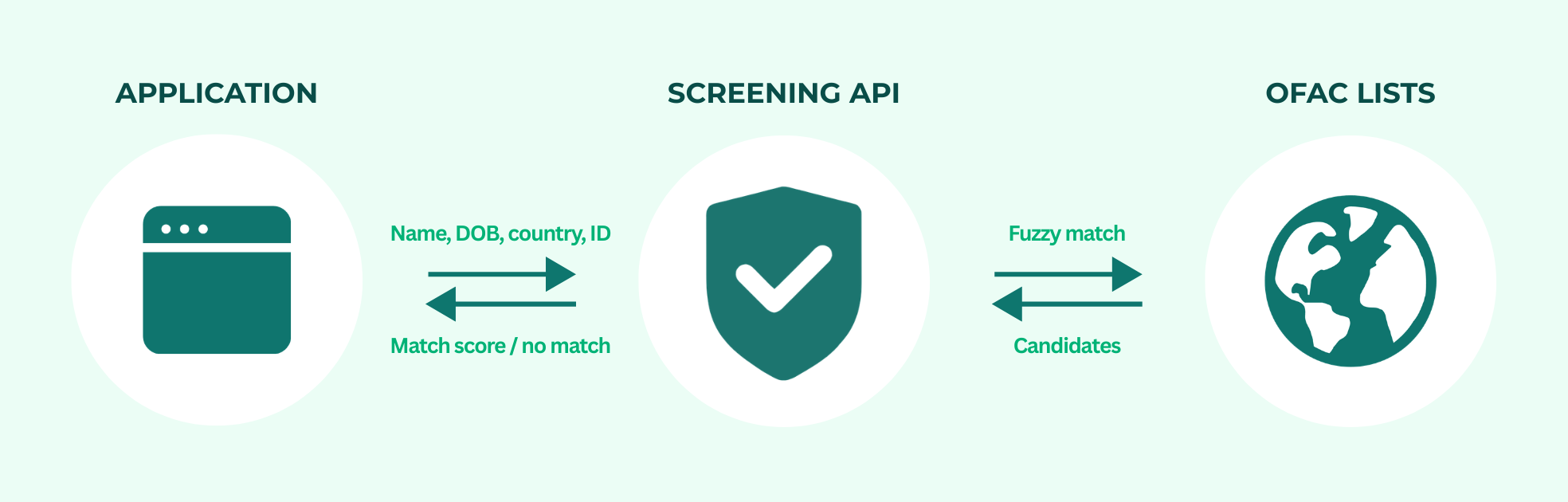
An OFAC API is a software interface that lets businesses automatically screen customers, companies, transactions, and other entities against OFAC sanctions lists.
Instead of manually searching sanctions databases, companies integrate real-time OFAC screening into onboarding, payments, and compliance workflows.
Banks, fintechs, payment companies, and compliance teams use OFAC APIs to identify sanctions matches before prohibited transactions are processed.
- How does an OFAC API work
- What sanctions lists does an OFAC API screen
- What data does an OFAC API screen
- OFAC API use cases
- Build vs Buy an OFAC API
- OFAC compliance requirements
- How to use an OFAC API
How does an OFAC API work
An OFAC API works by receiving subject data from your application, comparing it against OFAC sanctions lists, and returning a structured screening result.
-
Submit - Your system sends identifying data such as a name, company name, address, country, date of birth, ID number, vessel, aircraft, or wallet address.
-
Match - The API compares the submitted data against OFAC sanctions lists using exact matching, fuzzy matching, aliases, and other available identifiers.
-
Score - Potential matches are returned with confidence scores that show how closely the submitted subject matches a sanctioned party.
-
Act - Your system applies predefined rules based on the result, such as clearing the subject, sending it to manual review, or blocking the transaction.
This process can run in real time, making OFAC APIs useful for onboarding, payment screening, business verification, and other live compliance workflows.
What sanctions lists does an OFAC API screen
An OFAC API screens against two main OFAC sanctions lists: the Specially Designated Nationals (SDN) List and the Consolidated Sanctions List.
-
SDN List - OFAC’s primary blocking sanctions list. It includes sanctioned individuals, entities, vessels, aircraft, and digital currency addresses. If a party appears on the SDN List, businesses may be required to block, reject, or escalate the transaction under U.S. sanctions rules.
-
Consolidated Sanctions List - A combined set of OFAC non-SDN lists, including the SSI List, FSE List, NS-CMIC List, CAPTA List, and NS-MBS List. If a party appears on the Consolidated Sanctions List, businesses may be required to apply program-specific restrictions, reject certain activity, or escalate the match for review.
What data does an OFAC API screen
An OFAC API screens identifying data submitted for a person, business, vessel, aircraft, or crypto address. Submitting more complete data improves match accuracy and reduces false positives.
- Individuals - name, aliases, date of birth, nationality, address, ID number
- Companies - legal name, aliases, registration details, country, address
- Vessels - vessel name, IMO number, flag, owner or operator
- Aircraft - aircraft name, tail number, registration details
- Crypto - wallet or address data linked to OFAC entries
OFAC API use cases
OFAC API use cases usually fall into two groups: pre-relationship screening and event-based screening. Pre-relationship screening happens before a customer, vendor, or business account is approved. Event-based screening happens later, when a payment, shipment, ownership change, wallet address, or sanctions list update creates new exposure.
-
Customer onboarding - Screen individuals and businesses before account approval to avoid starting a relationship with a sanctioned party.
-
Payment screening - Watchlist screening for counterparties and transaction details before processing payments. A customer cleared at onboarding can still create risk through a later transaction.
-
Business verification (KYB) - Screen companies, directors, and beneficial owners during B2B onboarding. Sanctions exposure can sit at the ownership level, not only with the legal entity.
-
Ongoing monitoring - Rescreen existing customers when sanctions lists update. A customer who was clear yesterday may appear on a sanctions list later.
-
Crypto and blockchain - Screen digital currency addresses before processing transactions involving listed or high-risk wallet addresses.
-
Trade and logistics - Denied party screening for vessels, aircraft, owners, operators, and trade counterparties before cross-border shipments.
Build vs buy an OFAC API
The U.S. Treasury provides a Sanctions List Service API for accessing sanctions data files. It is a file delivery service, not a sanctions screening API. A commercial OFAC API returns screening results directly, with matching logic and scores built in.
| Feature | Official file API | Commercial screening API |
|---|---|---|
| Primary goal | File-sharing | Real-time screening |
| Search logic | Build yourself | Built-in fuzzy matching |
| Response | XML, CSV, fixed-width data files | JSON match results and scores |
| Maintenance | Parsing, storage, updates, matching logic | Integration and monitoring |
| Match handling | Build review logic yourself | Scores, explanations, and review workflows included |
| Audit trail | Build yourself | Often included |
| Best for | High engineering budget | Production-ready screening |
The official file API requires in-house development, matching logic, and ongoing maintenance. There is no fuzzy matching, scoring, audit logging, or workflow tooling, and no SLA or support if something fails silently.
Most teams underestimate the cost of a DIY build. The real cost is not OFAC data access. It is the engineering time, maintenance burden, and compliance risk of running screening infrastructure yourself.
OFAC compliance requirements
OFAC rules apply to U.S. persons and companies, and can also affect foreign businesses when USD payments clear through the U.S. financial system.
In practice, OFAC compliance means screening relevant parties, reviewing possible matches, documenting decisions, and keeping the process updated as sanctions lists change.
An OFAC API helps automate that screening layer across onboarding, payments, business verification, and ongoing monitoring.
It does not replace compliance judgment. Potential matches still need review, escalation, blocking or rejection decisions, and recordkeeping. Non-compliance can lead to civil or criminal penalties.
How to use an OFAC API
Using an OFAC API means placing screening inside the workflows where sanctions risk appears.
-
Choose an API: Compare list coverage, matching quality, response format, pricing, uptime, and support.
-
Authenticate: Create an API key and configure authentication in your backend environment.
-
Define screening points: Decide where to screen, such as onboarding, payment initiation, business verification, or scheduled rescreening.
-
Send complete data: Submit the strongest identifiers available for the subject type. Names alone create more false positives than names combined with dates of birth, countries, addresses, or ID numbers.
-
Handle results consistently: Use match scores and list details to define when to clear, review, block, or reject a result.
-
Keep records: Store screening results, timestamps, scores, and resolution decisions for audit and compliance review.
For the full implementation process, see our OFAC screening guide and documentation.